
Story by Sara E. Teller
Photos by Bernie LaFramboise
If you’ve ever had fresh eggs for breakfast,” Holly Belian says, “you’ll understand the first reason we wanted to raise hens.” Holly and her wife Julia have lived in Ferndale since the summer of 2009, and have been raising hens for the past four years.
Chickens in Ferndale? You bet.
Ferndale is one of several cities in Michigan that allow hens to be raised on your property. The list includes Berkley, Hazel Park and Royal Oak, among others. Ferndale has about two dozen personal chicken coops within the city. Holly and Julia both raised hens before, and when the opportunity became available to raise hens in Ferndale they wanted to give it a shot. They had both raised them in rural settings, in Southern Illinois and Texas, and trying it in an urban setting was intriguing.
The Details
City Ordinance No 1118 Sec 5-8 allows for residents in single-family homes to keep up to three hens in the backyard. Rental properties must supply the city with a letter of approval from the landlord. You need to submit a dimensioned site plan and pay a $35 permit fee at the time you submit your paperwork. The dimensioned site plan must include property lines, structures, set-backs, driveway and elevation of coop with materials. Plans must be to scale. Slaughtering of any chickens at the property is prohibited.
Benefits Of An Urban Farm
Besides delicious eggs, they’re part of Holly and Julia’s retirement plan.“We bought our house primarily for the extra deep backyard, and put in a big vegetable garden,” Holly said. “We also planted lots of fruit trees and bushes. Add in fresh eggs from the chickens, and we can almost become independent from store-bought foods.”
“The city presents a unique set of challenges and benefits to a homeowner,” said Laura Mikulski, who runs the web site, FerndaleChickens.com. “We have hawks and raccoons in Ferndale, which are chicken killers and strong steps have to be taken to prevent them from killing your birds. They add a layer of improvement to our sandy soil in Ferndale by way of their manure, which helps urban gardeners like myself.”
Ferndale resident Jill Marentette said hens fertilize gardens very well, and some residents might move their coops and the garden to get the maximum benefit.
Secret Garden
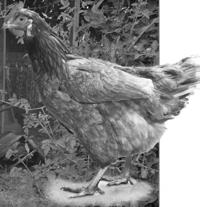
On a visit to Holly and Julia’s backyard, one finds more than just hens. Packed deep behind a lush growth of  blackberries, peach trees and tomato plants is the coop. There, we meet Dottie (a speckled Sussex), Figaro (Austrolorp) and Lacey (double-laced Barnevelder). Their hens survive just fine in the winter, although they don’t like stepping on the snow. They also have a tiny house for shelter, warmth and, of course, laying eggs. Hens typically lay an egg about once every 25 hours. So, on a given day, Holly and Julia get anywhere from zero to three eggs. While the $35 yearly permit fee may not make eating your own eggs much more feasible than buying them at a store, nothing beats homemade. “Their eggs are amazing,” Holly said. “Truly delicious, and we know exactly what goes into them.” Even the good, organic eggs you pick up at the farmer’s market can’t stand up to getting them from your own backyard.
Pesky Or Bothersome? Hardly.
These hens don’t mind strangers, although Dottie did give me a couple pecks on the leg when I entered her turf. But who wouldn’t be protective when a strange man comes into your coop? The hens made barely a peep.Laura even touted how great it can be to get to know a hen’s personality. “They can be kind to each other, or cruel, just like people,” she said. “They have a depth to their personality that I never expected. All of this has made me even more conscious of my purchasing habits, as the environment of factory farming seems more and more impossibly cruel after you see how much joy the birds take in living and being able to do chickeny things.”
Easy Upkeep
“There is almost no maintenance,” Holly said. “Feed has to be bought, but three hens don’t eat much. And instead of scraps going into the compost heap, we give them to the chickens to supplement. Fresh water  every few days in their thermos. We also provide some grit to help them process the eggs, and diatomaceous earth to roll in during the summer to keep them bug free.” Holly and Julia clean or resurface their yard two times a year, and regularly check the yard to make sure it’s secure from critters. Julia said they do see some digging from time to time, but their hens have never been in danger.
Learn More
Do you know anybody who raises hens? Interested in pursuing it yourself? Check out ferndalechickens.com for easy-to-find and easy-to-read information on what Ferndale residents needs to know. You’ll also find help tips and education blog posts. “We support each other and communicate in times of need,” Laura said. “This is true of Ferndale and beyond. Neighboring cities use Facebook and social media to reach out to fellow chicken keepers for advice and help when medical needs arise.”

 the Green Cruise, says. “It’s an all-around environmental event, and it’s going to benefit more than just one charity and one idea; we’ll support a whole gamut of things such as energy conservation, using less fossil fuels, getting bad chemicals out of the air and native landscaping.”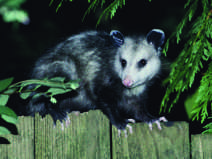
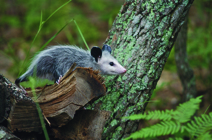 North America’s only marsupial. Marsupials are archetypal mammals that cannot produce a placenta, and instead sport a pouch in which they carry and suckle their young. Do not let their slow movements fool you. With their opposable ‘thumb’ toes and their prehensile tails, they are great climbers. You may have seen one hanging upside down by their tail in a tree. They are also rather smart and have fantastic memories.
 horizon as the most difficult issue we will face in this country and as a planet – clean, affordable, accessible fresh water. We must get people talking about water, get them to the water to connect with it, educate them and inspire them about it, and introduce them to the many ways they may get involved with the cause.”
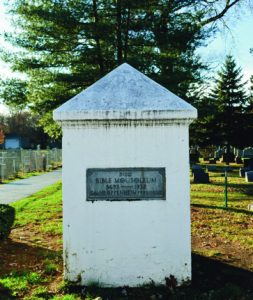 Machpelah Cemetery is worth a long, winding walk. The Jewish cemetery is located on Woodward, just south of Marshall road, across from a car dealership and surrounded by businesses. Despite the busy area, the cemetery is a very peaceful place, 24 acres of immaculate landscaping backed by the David Oppenheim Memorial park. The cemetery has 9000 garden beds and circling walking trails. Machpelah has won an America in Bloom award, as well as a Ferndale Beautification award, with good reason. There is a year-round crew that keeps Machpelah beautiful. Weeding and garden maintenance is a nonstop task, starting at one end of the park and restarting as soon as they reach the other. The crew also must level out between 300 and 500 graves and tombstones a year. Along with the tradition of having a groundskeeper on the property, Machpelah is also one of few cemeteries that hand digs each grave.
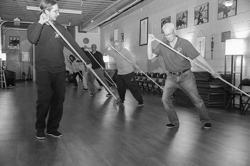 University for a couple of years.” From 1975 to 1995, he work-ed at Pontiac Osteopathic Hospital. Since 1995, Sifu Ashmore has been teaching Tai Chi full-time. He has taught Tai Chi in many area hospitals: Beaumont, U of M Hospital, Henry Ford Hospital, and others. Now he teaches full-time at the Ferndale school.
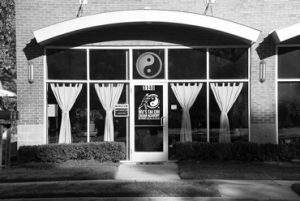 Chi, a soft-style martial art, differs from the hard-style martial arts, “You don’t use muscular tension to generate force…you use looseness and coordination of the muscles…stretching the muscles out and then coordinating all the joints in a unified way to whatever leverage goal you are looking for.”
 in the eyes of those who have dwelled there for centuries. It is a precarious situation for all parties in finding common ground, and it touches on many facets of the world at large; including a government that claims to protect vulnerable populations from the interest of private companies, and to hold true to the treaties and agreements that were made with America’s Native People.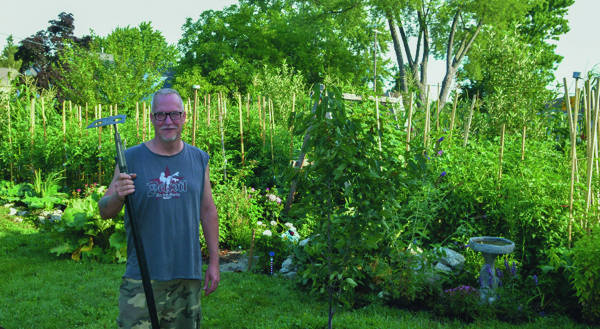
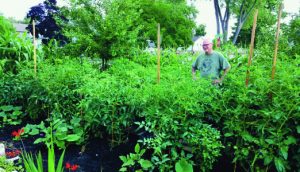 pumpkins, green onions, jalapenos, pimentos, bell peppers, asparagus, grape leaves, okra, potatoes, beets, pole beans, carrots, sweet potatoes, lettuce, chilies, kale, and cucumbers, just to name a few. He has a handful of fruit trees, including pears and apples, as well as melon and berry plants throughout his garden. There is also a wide variety of spices and herbs. Bernie places plants strategically,like encouraging companion growing by mixing basil plants in between his tomatoes. The entire yard is also lined in beautiful flowers and hanging baskets that attract bees and butterflies.
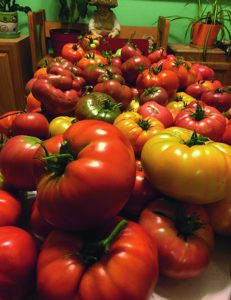 the growing energy to the tomatoes themselves. Collecting rain water is very useful – Bernie’s 250-gallon tank helped him make it through the heat spell this summer.
 Prev
Prev